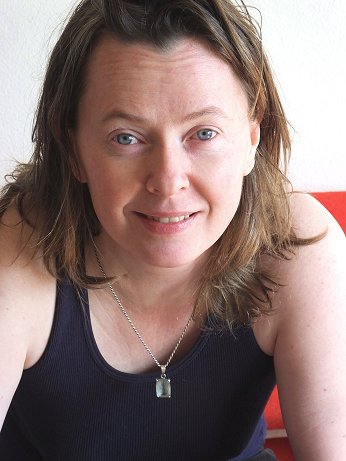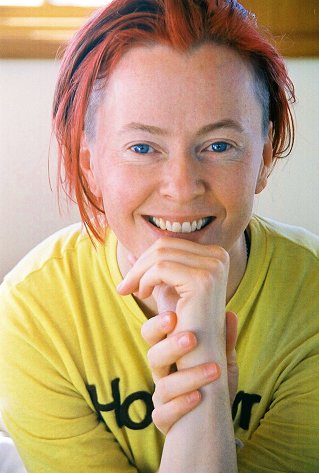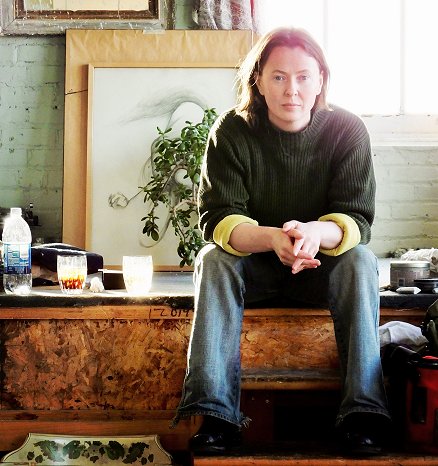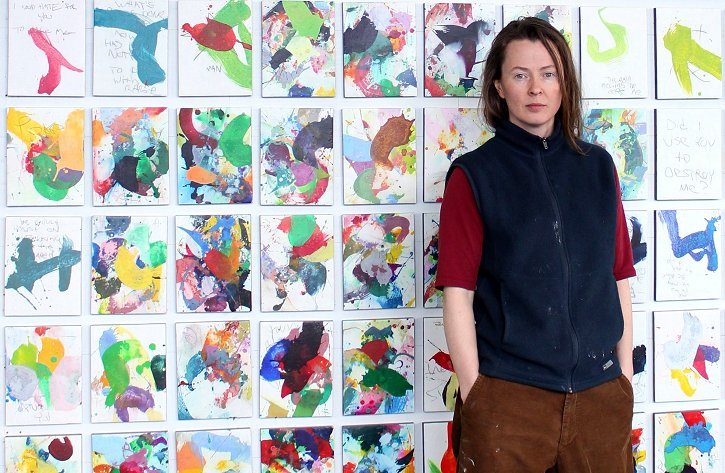
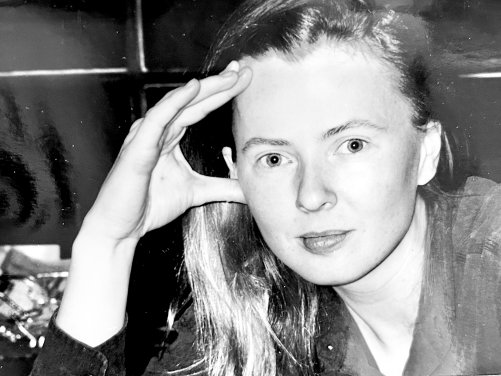
(portrait by Stephen Kurowski; all other color portraits by Richard Speer)
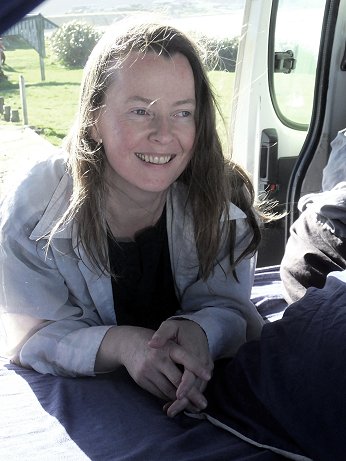
Dorothy Eileen Goode
(portrait by
Stephen Kurowski; all other color portraits by
Richard Speer)
Dorothy Eileen Goode
October 4, 1969-November 23, 2020
"I am interested in freedom. And I use props."
Interview with Dorothy Goode by
filmmakers Stephen Kurowski and Marina Tait
Beloved Portland-based artist Dorothy Goode passed away on November 23, 2020, in her apartment in southeast Portland. She died in her sleep, peacefully but unexpectedly, of a pulmonary embolism. An autopsy revealed a heart condition and other underlying conditions that had not been previously known.
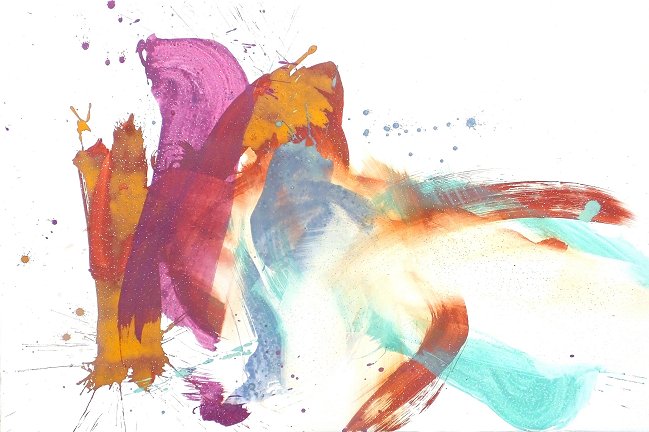
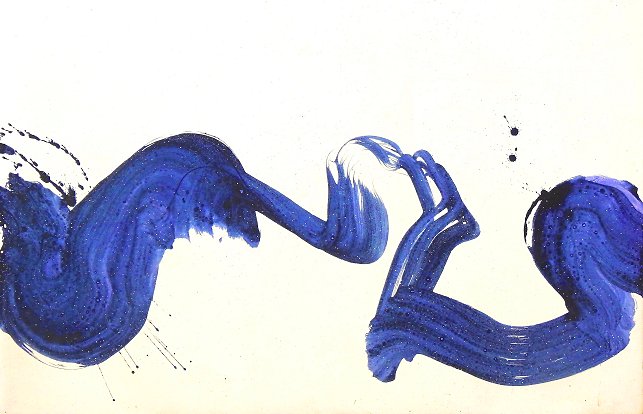
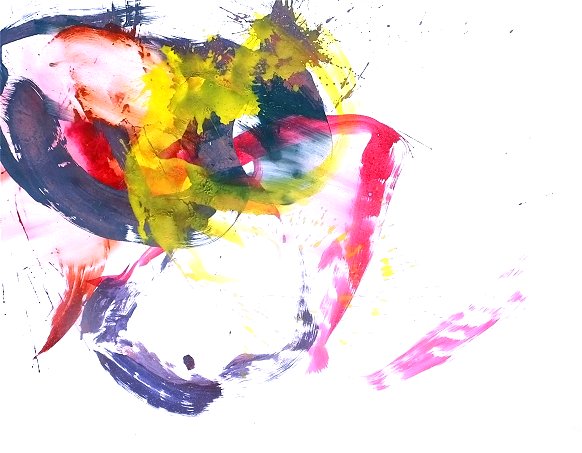
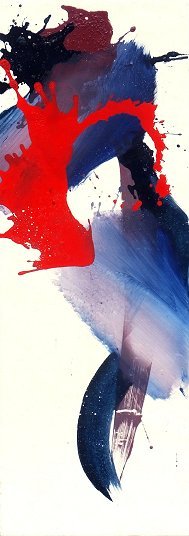
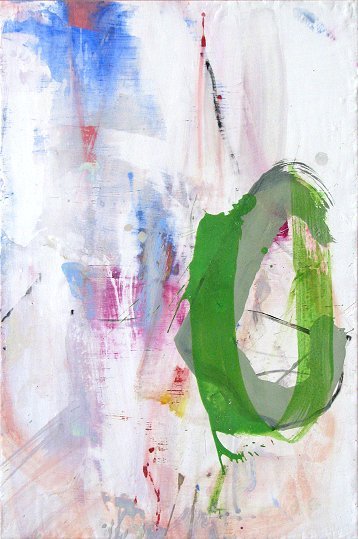
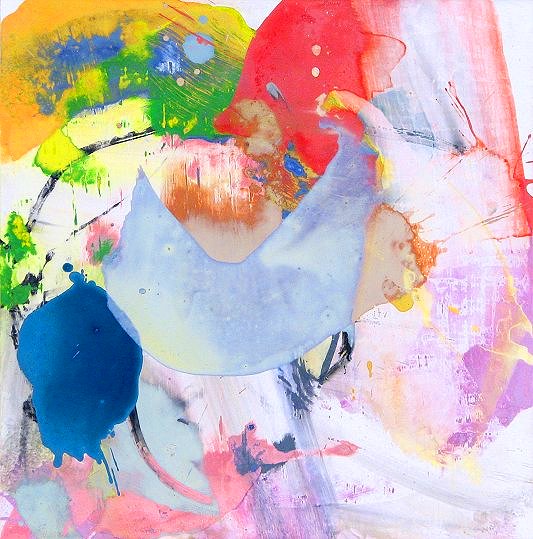
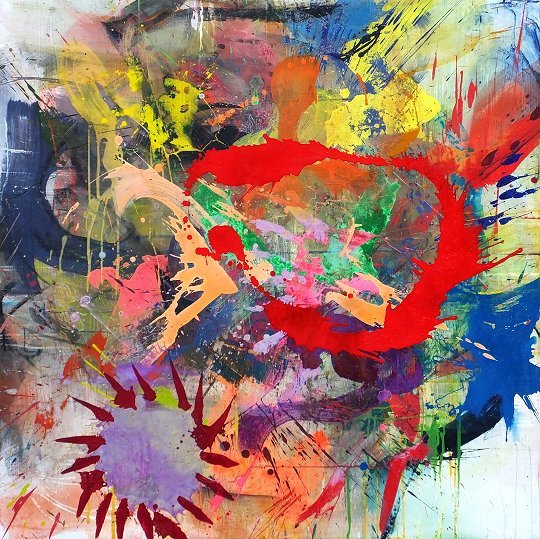
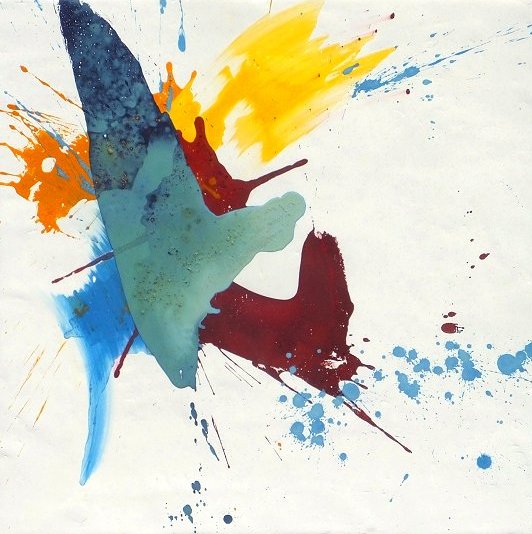
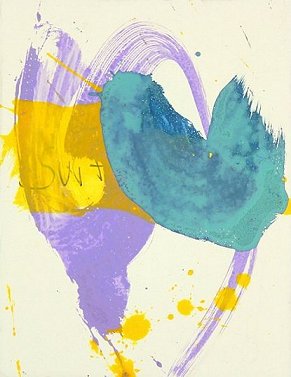
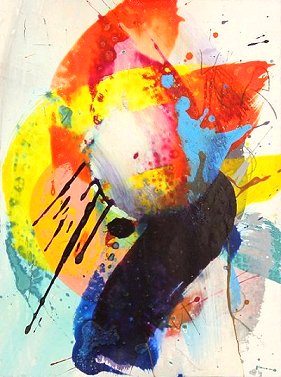
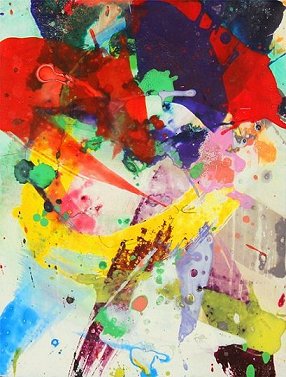
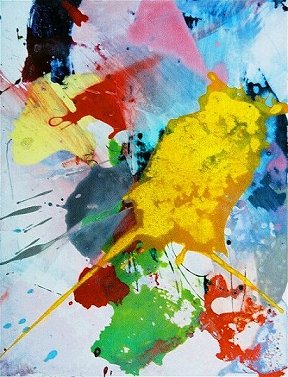
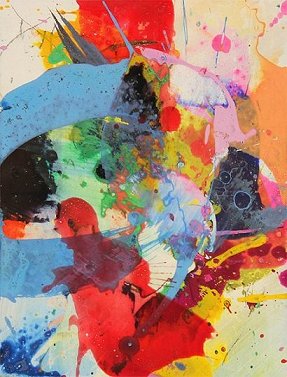
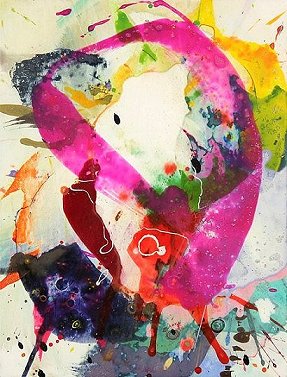
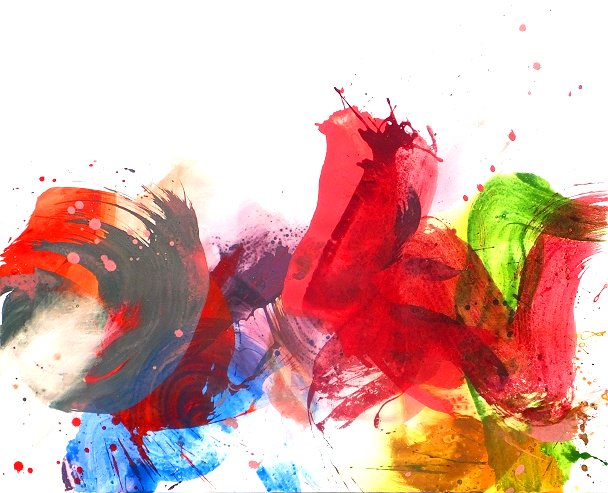
During a 30-year career centered in the Pacific Northwest, Goode was known for her exuberant compositions in the vein of lyrical abstraction. Deploying egg-tempera paints—a medium associated with Byzantine and early Renaissance art—in a striking integration of ancient and modern, she layered and excavated translucent gestures in an array of bold and subtle colors. She viewed her compositions as “moveable math problems” to be solved through a blend of painstaking deliberation and inspired improvisation. Often she would sit in yoga poses contemplating a panel for hours before rising to make a single, definitive mark.
Born in Santa Rosa, California, to James Bruce Goode and Patricia Ann Tuft Goode, she grew up south of Point Arena with older siblings Kevin and Marji. The family lived on a back-to-the-land compound, where they raised goats, chickens, rabbits, geese, and turkeys. It was here on the fog-shrouded precipice of the Pacific Ocean, surrounded by redwoods and pampas grass, that she learned the virtues of self-sustenance, hard work, and farm-to-table cooking. Throughout her life she delighted in preparing hearty stews, pastas, and curries for family and friends; baking pies with Marji was a perennial holiday tradition. The family moved to Prescott, Arizona, in 1984.
A precocious student, Goode (known to her friends as "Dori" or "Dory") graduated high school and began college at age 16 at Northern Arizona University, studying illustration, printmaking, and painting. After moving to Portland in the 1990s, she was discovered by Butters Gallery, which exhibited her work for the better part of two decades. She also had solo and group exhibitions in Los Angeles, San Francisco, Seattle, Santa Fe, Atlanta, and Nagasaki, Japan. Her final exhibition during her lifetime, “Transfixed,” was held at Augen Gallery in December 2019. Of that exhibition, arts writer Friderike Heuer observed: “What drew me in was the sense of something moving, of speed--giddy and compulsively driven... playful beauty, geometric lightness in 3D.”
As a parallel practice to her paintings, her graphite and ink drawings exuded wry humor and outrageous, sometimes risqué, imagery. The do-it-yourself ethos of her childhood lingered in her art practice. She cooked her own gesso; sanded, braced, and framed her own panels; and painstakingly cross-hatched her intricate early drawings, sometimes investing hundreds of hours in a single work. Her only slightly tongue-in-cheek motto, scrawled onto her studio wall, was: “Maximize difficulty for fun and profit.” The historical artists she most admired were John Singer Sargent, Egon Schiele, and Willem de Kooning.
For many years her day job was shelving books at the Multnomah County Library, where she made many lasting friends. She was a prolific reader whose library numbered in the thousands. Her favorite authors were Jane Austen, Virginia Woolf, Edith Wharton, Sigmund Freud, Luce Irigaray, Jacques Lacan, Simone de Beauvoir, Paul Bowles, Anaïs Nin, Jean Genet, Haruki Murakami, Alan Hollinghurst, and Paul Theroux. Also an inveterate journaler, in later years she chronicled her journeys across Alaska, New Zealand, Australia, Nepal, Japan, and Mongolia. A lover of the open road, motion, and expansive vistas, she was rarely happier than when behind the wheel of her 1979 Ford Econoline van, which she drove intrepidly around the country, culminating in an epic 2014 road trip from Portland to Alaska and back. In 2019, for her 50th birthday, she fulfilled a dream to ride the Trans-Siberian Railway from the Russian Far East all the way to Moscow and St. Petersburg.
A complex personality and fiercely opinionated feminist, she also had a warmer, gentler side. She was a lover of animals, especially goats and rodents, and of “Rocky” movies, of which she was a devotee. “Zoolander” was another favorite, as was "The Adventures of Priscilla, Queen of the Desert," the dialogue of which she could practically recite from memory.
Music was a passion. She grew up listening to her father playing piano and spinning records on the family stereo. Her favorite piece of classical music was The Well-tempered Clavier by J.S. Bach, followed closely by Bach’s suites for solo cello. In popular music she was a fan of Joni Mitchell and Prince, and was a late but enthusiastic convert to karaoke, belting out tunes by Conway Twitty, George Michael, Gordon Lightfoot, and Hank Williams, Jr...
She knew how to man a tiller on a sailboat, confidently steering her friend Jon Erikson’s boat on many a pleasant evening with friends on the Columbia River. She was also a much-loved member of her yoga community (she practiced a style called Shadow Yoga) and her "Land" community, a group of longtime friends who gather every summer in the mountains east of Ashland, Oregon.
Her untimely death has been greeted with deep sadness by the art community as well as her family and friends around the world. Predeceased by her mother, Patricia Goode, she was survived by her father James Goode, brother Kevin Goode, sister Marji Goode-Sjogren, nephew D.J. Brown, nieces Samantha Sjogren and Katie Sulista, and life partner Richard Speer.
—Obituary of Dorothy Goode by Richard Speer, November 2020
Dorothy's artist statement
for the series Paintings I Wrote on in 2009:
I was born in 1969 and raised by hippies in the wilds of Mendocino County, California. Then followed a stint in Northern Arizona, where I got my college degree and tangled with books, line drawings, and youth. But soon enough I heard the call of the city, and during one of many epic drives in my Ford Econoline van I found Portland, Oregon, where I have lived without regret ever since.
Making art is a lonely and layered business, and it helps if there is some kind of love involved. My first great lonely love was line, and the human form its ultimate aim. But even as I cut my teeth on the study of physicality and flesh, I sensed something less purely demonstrable within my compulsion to catch at things. In my youth I referred to this “thing” as The Moment, and I am still liable to resort to the term when other words fail, as they like to do. A moment, strictly speaking, is something that defies the straight glance. It also requires propping and must be represented if one means to account for it. I, like many who came before me, need the solace of the sensible—or that which holds still. A moment does not hold still. But something done in a moment will, or can, if one uses a tool in a certain way. I like simple tools best. I like, even, bad tools—ones that are regular, but just a little reluctant.
It is far too easy for everything to become precious—perhaps art and art-making especially. A “significant” moment-object-expression is to be determined through human action, one way or another, and held up as absolutely distinct from the less significant. The art object, as far as I can tell, is one of our favorite things to stand in for the significant in human life. It allows us to rest our senses against it and bask in the illusion of its reality. I do not know how real these things actually are, even as I pore through my own precious moments, seeking the transient yet static answers within. However, ambivalence is a beautiful thing, and not without its own symbolic value—as is the illusion of beauty, arrested in its flight from here to there, bringing with it its scaffold, its skeleton.
Curriculum Vitae/Exhibition History
Selected
Solo and Group Exhibitions
2025 (posthumous) Dorothy Goode:
Al Fresco, Oregon City, OR
2024 (posthumous) Dorothy Goode: A
Retrospective, Augen
Gallery, Portland, OR
2022 (posthumous) Dorothy Goode: Jubilant–The Final Paintings, Augen Gallery, Portland, OR
2020 Cascade AIDS Project "Curator's Choice," curated by Brett Binford, Portland, OR
2019 Transfixed, Augen Gallery, Portland, OR
2019
40th Annual 8.9 Peace Exhibition,
Nagasaki Prefectural Art Museum,
Nagasaki, Japan
curated by Hideo Sakata
2018 Phraseology, Butters Gallery, Portland, OR
2018: Cascade AIDS Project Live Auction, curated by Grace Kook-Anderson, Portland, OR
2017
Sanctuary City: With Liberty
and Justice for Some
San Francisco Arts Commission, San
Francisco, CA
2017 With Liberty and Justice for Some, Walter Maciel Gallery, Los Angeles, CA
2017
Hypochondria Drawings, Helzer
Gallery, Portland Community College,
Portland, OR
Curated by Prudence Roberts
2016 The Coast is Queer, KALA, Astoria, OR, curated by Mark Woolley
2016 But... I Wanna Be a Robot, Butters Gallery, Portland, OR
2015 They're My Friends -- I Made Them, Three30Forty, Oakland, CA
2015 The Scarcity Paintings, Butters Gallery, Portland, OR
2014 Sharpie Looks for God,
Toomey-Tourell Fine Art, San Francisco,
CA
2014 Cascade AIDS Project Live Auction,
curated by Prudence Roberts, Portland,
OR
2014 Perversities and Confessions,
Cock Gallery, Portland, OR
2013
Organic, Butters Gallery,
Portland, OR
2013 Introductions, Anne Irwin Fine Art, Atlanta, GA
2012
Cascade AIDS Project Art Auction,
Portland, OR
Curated by Bonnie Laing-Malcolmson,
Portland Art Museum
2011 Identity Paintings, Worksound, Portland, OR
2011 Pretty Mess with Words, Butters Gallery, Portland, OR
2010 Gifted, Littman Gallery, Portland State University, Portland, OR
2010
Paintings I Wrote on in
2009, Butters Gallery, Portland, OR
2010 Recent Work,
Davidson Galleries, Seattle, WA
2010 Little Gems,
Butters Gallery, Portland, OR
2009 Paint as Subject, Emily
Amy Gallery, Atlanta, GA
2008 You Know How I Feel,
Center for Contemporary Arts, Santa Fe,
NM
2008 Grand Opening Group
Show, Emily Amy Gallery, Atlanta, GA
2008 Introductions, Seattle
Art Museum Gallery, Seattle, WA
2008 In Homage to the
Graffiti I Didn't See in Manhattan, Butters
Gallery, Portland, OR
2007 Artists Go Lightly,
Temporary Autonomous Museum(s), San
Francisco, CA
2007 Summer Salon, bsg
Modern, Atlanta, GA 2007
2006 Dorothy Goode: New Work, Butters Gallery,
Portland, OR
2004 Gesturing, Butters Gallery,
Portland, OR
2004 Dorothy Goode: New Work, Butters Gallery,
Portland, OR
2004 Art for Life, Cascade AIDS
Project, Portland, OR
2004 Mark Palmer Gallery, Paducah, KY
2003 Evasion, Butters Gallery,
Portland, OR
2002 Ecstasy: Mind, Body, Spirit,
Orange County Center for Contemporary
Arts, Santa Ana, CA
2002 Visions International, Art
Center Waco, Waco, TX
2002 National Woman’s Exhibition,
Impact Artists’ Gallery, Buffalo, NY
2002 Aesthetics 2002, Birger
Sandzen Memorial Gallery. Lindsborg, KS
2002 Persistence: Figure, Butters
Gallery, Portland, OR
2001 Dorothy Goode, Butters Gallery,
Portland, OR
2001 Artist Edit, Butters
Gallery, Portland, OR
2001 Drawing II, Period Gallery,
Omaha, NE
2000 New Drawings, OMNI Gallery,
Portland, OR
1999 Davis Street
Inaugural, Butters Gallery,
Portland, OR
1998 Omni Gallery, Portland, OR
1997 Palace Gallery, Portland, OR
Education and Residencies
Bachelor of
Fine Arts, Northern Arizona University,
1990
Studied painting, printmaking, drawing, and
illustration
in the University's Visual
Communications Program.
Illustration studies directed by
Professor
David Christiana.
Drawing
and printmaking studies resulted in the
book, Touch,
a collected series of 15 offset lithographs made
from pen and ink drawings
published by Northern Arizona
University, 1990
Newport, OR (2001)
Oracle, AZ (2002)
2003 Dorland
Mountain Arts Colony, Temecula, CA
Paducah, KY
(2004)
Taos, NM (2011)
Critical Praise
Friderike Heuer, Oregon Artswatch, January 2020:
“What drew me in was the exuberance in these paintings and the sense of something moving, of speed... in equal parts giddy and compulsively driven, a perfect tension between lifting your soul up and weighing your heart down with the emotional valence behind those expressions... Overall it is the expansiveness of the gesture that is the catalyst for the psychological impact... Things merging and overlapping have blossomed into full form in Goode’s abstractions. She also frequently experiments with flat fields of colors and strong contours... It struck me as joyful, in the Nabi tradition: playful beauty, geometric lightness in 3D.”
Visual Art Source, December 2019:
“In a unique and anachronistic fashion, Goode paints with egg tempera, a medium usually associated with Byzantine and Renaissance art, to create ebullient gestural paintings in the lineage of Abstract Expressionism and Lyrical Abstraction. Tempera imparts a startling translucence to her vibrantly hued brushstrokes and excavated surfaces, allowing viewers to peer through many layers of materials and process. Elegant and assured, the paintings convey buoyancy, kineticism, and complexity, encapsulating a lifetime of journeys and aesthetic inquiry.”
Art Business, April 3, 2014
Review of Sharpie Looks for God at Toomey-Tourell Fine Art (San Francisco, CA)
by Kathryn Arnold“...In Dorothy Goode’s Sharpie Looks for God (Toomey-Tourell, San Francisco), joyous, conjoined splashes of color are occasionally embellished with snippets of text. A sense of spontaneity informs the informal compositions. A few harken reminders of Sam Francis, yet Goode’s color-blended-with-text art displays a sense of play...”
ARTSYforager, May 16, 2013
"Painting Confidences: Dorothy Goode"
by blogger Lesley Frenz“We all have that friend, the one everyone confides in and is completely confident their secrets will be taken to the grave. In her Other People’s Secrets series, Portland artist Dorothy Goode has found a way to get those piled-up secrets out, without ever truly spilling a single one. The artist began each panel by dipping her fingers into sumi ink, then sprawling secrets over the surface of each panel, first her own and then the confidences of others came leaking out. The letters and forms are mostly illegible, making sure that each secret is still safely hidden. Once the secrets are spilled, the artist then covers them with colorful, scrawling abstract gestures in paint. In that final step, I see an analogy to the way we live with our own well-kept mysteries; we hide them in plain sight, often burying them just beneath the brightly colored surface.”
Meg Biram: The Edit
Lifestyle Blog featured in The Washington Post
February 27, 2012
Article: "Art to Fashion: Heidi Merrick + Dorothy Goode"
Visual Art Source, May 15, 2010
"Recommendation: Dorothy Goode""In Paintings I wrote on in 2009, Dorothy Goode introduces a new element to her visual vocabulary: graphite scrawls that spell out formal messages both cryptic and self-revelatory. The texts are for the most part obscured behind layers of impasto, lending the works an electric tension between expression and concealment. As she has in previous bodies of work, Goode favors a palette of bold reds, blues, oranges, and greens, which pop against the panels' white grounds. Her curvilinear gestures, vaguely biomorphic, cluster in the center of each composition, as if tugged by centripetal force.
More hyperkinetic and dense than the work in her previous 2008 outing, Homage to the Graffiti I Didn't See in NY, the painter now cedes Zen-like elegance to maximalist furor. Whereas the surfaces in Homage... whispered with the translucence of egg tempera, the current surfaces are more painterly and exhibit a greater variety of application, at times recalling the squeegee-happy marbling of Gerhard Richter's paintings in the vein of Abstract Expressionism. Happily buoyant, Goode's panels escape the gravity of their historical antecedents, thanks in large part to the graphite doodles undergirding her arcing gestures. This mark-making lends a confessional, Gen-Y quality that feels thoroughly contemporary to the age of blogs and Facebook. The artist channels the Zeitgeist's uneasy duet between insularity and extroversion."
Burnaway, April 27, 2009
"Emily Amy Gallery: Paint as Subject"The new show at the Emily Amy Gallery, “Paint as Subject,” features a delightful selection of paintings whose focus is paint itself. Dorothy Goode, James Leonard, Melanie Parke, and Carl Plansky are all talented artists reviving the modernist aesthetic and theory that a painting should remain true to itself.
As you enter the gallery space, you immediately encounter Dorothy Goode’s work, consisting of splashy, bold colors with lots of white space, black lines, and scratching into the egg tempera paint such as in Big Squares 12. There are many layers of paint on each panel, but overall the surface remains flat. In this painting and others, there are still some figurative elements, as if a person has been suspended in time before the viewer’s eyes. Goode’s use of bold colors against a predominantly white background and the texture created by the layers of paint make her work some of the most visually interesting of the exhibition...
The Oregonian/OregonLive.com, February 17, 2006
"Smashing Flow" by TJ NorrisIf Abstract Expressionism had been born yesterday, Dorothy Goode may have been the doyenne of it all. Butters presents two new series of her works called Medium matters: Echo and Circular Saw. In the Echo series, the smaller of the two groupings, she recreates the relationship of an old-fashioned technique of egg tempera on panel. In these 16”X11” beauties, her white-washed variations of color and deliberately improvised mark-making reminisce with modern-day graffiti and its removal within the same context. The works are little capsules, or windows, into urbanity. Feathery lines and double layers of hidden meanings or secret languages. Though there is no actual text, her corrugated approach to stylizing or redefining shapes through obliterating parts of them is as romantic as it is cryptic. Some are simplistically immediate (Echo Series 8), while others are a bit of an acid wash rapture of off-beat color (Echo Series 13). What works mostly about this series is that they can be viewed micro/macro and still offer an impression; they are like contained, blown-up details of a de Kooning (formalist, not feminist perspective). In this same breadth, this is what remains puzzling about the work, the quality of editing something that would ordinarily be uncontainable.
Her other Circular Saw series here, all from 2006, are extensions of the smaller pieces, less “framed” at 48”X 16” – but also more minimal somehow – incorporating mixed-media sculptural elements and attempting to reveal the naked and partially deconstructed panel surfaces. These pieces, though spiritedly physical on the whole, seemed less realized to me, though the elongation and gestural immediacy do have a tribal-like quality. Color seems to be to a lesser extent the focal point as layers of whites coat the surface of color, creating various neutrals. This approach dictates a haze of meaning, a cover-up, bloody secrets in the snow (Circular Saw Series 7). Open shapes are hinted at when revealed and concealed, but Goode prefers the double-take in order to discover something hidden in the light of looking: something about the act of the momentary gaze, just under the surface.
The Oregonian, Arts & Entertainment, February 10, 2006
"Medium Matters"Dorothy Goode’s skill as a painter is well-evidenced at Butter Gallery this month in a show of recent works – very recent, in fact; most of the paintings on display were completed in 2006 – called Medium Matters.
The words on exhibit include Goode’s visceral, elongated Circular Saw series and the larger Drawing on Unstable Ground #11 and #12. In the latter, the artist’s compositions are created from austere crusts of plaster, at times so heavily worked that the wood panel beneath shows through in chipped and shredded swatches or the darkly secretive maw of a puncture.
Then there is the more delicate Echo series, done in egg tempera on wood panels. These vary from the stark, elegant gesture of black and gold that is Echo Series #11 to the more densely layered membranes of almost edible lemon and grass-green hues in Echo Series #19. They’re marvelously energetic, but it’s a suggestively diffuse energy, as though the vigorous musicality of a Kandinsky had been submerged in water until its hard edges dissolved. Kandinsky himself said, “The more abstract is form, the more clear and direct its appeal,” and Goode does well by that advice.
Willamette Week, April 14, 2004
"April Round-up"Perhaps the most arresting works at Butters this month are in the back-room group show. Dorothy Goode's new paintings in the vein of Abstract Expressionism exult in bold strokes in pink, raspberry, and chartreuse. Who knew such soft colors could pack such a virile punch?
Thank you for your
interest in Dorothy Goode,
brilliant artist and radically unique human being
who is profoundly missed by all of us who loved her.
Dorothy's Instagram account remains up
@dorothyeileengoode.
Facebook account is
https://www.facebook.com/dorothy.goode
Please direct questions about Dorothy Goode's life
and art
to her surviving partner and artistic executor
Richard
Speer.
BACK TO RICHARD'S WELCOME PAGE