|
|
|
|
Artist
Statement:
I suspect the
secret aim of
every artist is to not only
communicate
effectively about
their own perspective on life,
but
to create art that is so
powerful that it actually
induces an altered state of
consciousness in the
viewer.
A sudden transcendent
awareness of the
sublime, the
ecstatic and ...
Further
Information | |
Artist Exhibitions:
GROUP
EXHIBITION
2005 Lawrence Gallery,
Porland, OR
2004
Lawrence Gallery,
Porland, OR
2003 Palace of Fine Art,
San
Francisco, CA
2002 Palace of Fine Art, San
Francisco, CA
1994 Nike World Headquarters,
Beaverton, OR
SOLO SHOWS
1996 -’99 The Vault,
Portland, OR
1996 Sunridge Gallery,
Dunsmuir, CA
1995 Visual Art ...
Further
Information | |
Artist Galleries:
Lawrence
Gallery
903 NW Davis St.,
Portland, OR 97209
1-503-228-1776
http://www.lawrencegallery.net.
..
Further
Information | |
|
|
|
|
|
| |
|
"Transliterating the Transcendent State: Barry
Mack's Doorways"
by
Richard Speer
Barry Mack is a painter of
transcendent experience in its manifold varieties. Passionately,
persistently, and from a myriad of approaches, he has pursued this
elusive theme since 1988. It was that year when, in the middle of
the night—and unaided by any psychoactive substances—he found
himself swept up in a spontaneous rush of creative euphoria, the
intensity of which he had never before experienced. After a fleeting
immersion, he emerged from the euphoric state, the effects of which
lingered for several days, albeit in diluted form.
“I’ve
been trying to get it back ever since,” the artist says today.
“That’s why I paint what I paint.”
Given this genesis as a
serious conceptual painter, it is entirely fitting that Mack’s
current body of work is entitled Doorways, for it would not be an
overstatement to suggest that his life’s mission is to paint
Blake’s, Huxley’s, and Morrison’s perceptionary doors as if cleansed
and infinite. As the artist explains it, the new paintings are
“intended to be expressions of what an actual epiphany might look
like: the utterly mysterious appearance of something far beyond
mundane reality.” This is a tall order, and he who undertakes such a
mission embarks on a journey of visual metonymy, of transliteration:
converting characters in one alphabet into corresponding characters
in another. Instead of transliterating Cyrillic to Greek, or
Sanskrit to Kanji, Mack is transliterating ecstatic vision into an
aesthetic experience via earthbound materials like pigment,
acrylics, and linen. He is a reconnaissance scout venturing into
foreign territory, then circling back around to convey his
discoveries to the rest of us via the tools of the artist.
How exactly does a painter condense into a two- or
three-dimensional image the “Eureka!” of Archimedes, the ecstasies
of Joan of Arc, the apple-tree revelation of Isaac Newton? Mack took
inspiration from Tanner and Rembrandt (he cites Belshazzar’s Feast,
while I see The Night Watch), and osmotically channeled Caravaggio,
I submit, riffing on the light-play of The Calling of Saint Matthew.
The results of these influences, filtered through his unique
pictorial imagination, may well be the most symbolically pregnant
paintings of his career.
I have written before (see my
introduction to Light on the Horizon) about Barry Mack’s fascination
with the intersection of terrestrial and extraterrestrial, inner
space and outer. In previous works like Awakening, the painter
conjures fantastical landscapes that look like cinematic/painterly
hybrids of Peter Jackson and Childe Hassam. These vistas, with their
chasms and volcanos, yield to abstractions in Mack’s Ancient Light
series. An interest in supersensory light is also evident in Final
Ascent, which looks up from pyramidal structures towards a radiance
in the sky that might be a solar event, a mothership, or the eye of
God. And in High Above, a crucifix erected upon a Southwestern
landscape is dwarfed by the enormous vault of heaven, whose
O’Keeffean clouds swaddle a light source of inscrutable origination.
The neo-transcendentalist overtones in these works are clear. In the
tradition of Emerson and Fuller, Mack is stretching beyond the
sectarian towards the universal. The transcendentalists studied
Eastern mysticisms and believed that a spiritual ideal wider than
that afforded by Christianity was graspable through meditation,
intuition, and communion with nature. As their intellectual heir,
Frank Lloyd Wright, famously noted, “I put a capital ‘N’ on nature
and call it my church.” Mack’s own church is the infinity between a
human being’s ears.
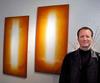
As the central figure in Doorways, the
painter employs pillars of light that sear like phosphenes into the
viewer’s eyes. Perhaps they are luminous impressions lingering from
a Samadhi exchange between Mack and metaphysical teacher Leslie
Temple-Thurston in an early 2005 workshop. Interestingly, the
paintings’ vertical pillars, vaguely rectangular in form, evoke the
monoliths in Kubrick’s 2001: A Space Odyssey, which represent
pivotal catalysts in man’s evolution from ape to rational animal to
Star Child. Like the radiant inscription in Belshazzar’s Feast,
Kubrick and Clarke’s monoliths—and Mack’s Doorways—visually
metonymize a contact with a wholly unknowable intelligence, to which
the only possible response is awe.
But while Mack’s pillars
appear monolithic on first glance, they reveal themselves upon
closer inspection as highly nuanced with swirly drips and
interference colors; and gradations from white to yellow to orange
to burnt umber; and a liquid-looking, ambery surface resulting from
up to 100 layers of paints and varnishes. In In The Doorway, the
drips approximate spermatozoa conglomerating around the light
source’s center, as if a metaphoric fertilization were about to take
place. With its two pillars capped by a horizontal element, the
painting suggests the mathematical Pi or post-and-lintel
construction, which the Greeks employed aesthetico-mathematically to
produce the visually perfect Golden Rectangle. In the expansively
titled Doorway into the Partially Veiled, Melting, and
Dematerializing Landscape, four light sources are linked by a
horizontal element just below the picture plane’s midpoint, a
jaunty, devil-may-care gesture contrasting with the linear divider.
I see a Zen influence in the triptychesque In the Doorway,
The Appearance of One, and Another Appearance, and in the Form and
Freedom series. These latter stand among the most haunting in the
current body of work, for their juxtaposition of square emanations
with luscious, painterly gestures reminds us that these are, after
all, paintings, not just metaphysical statements. The
expressionistic gestural caps—curvy in I, straighter in II, straight
in III—are so calligraphic, so free, so creamy in application, they
absolutely make the series. By contrasting the ethereality of the
light blocks with the physicality of the single overarching
brushstrokes, these striking works show the harmonious coexistence
of Mack’s talking-point oppositions of light/dark and male/female
and suggest a dialectic integration of these polarities. Form and
Freedom I, in particular, may be as close as Mack has yet come to a
minimalist masterpiece.
The light is more diffuse in Light
on White Mountain, spreading across the canvas rather than
concentrating in one mass, as if to evoke the oceanic rush, the
outward-spreading warmth punctuated by giddy coolness, of the body
high. Micro Monolithic Landscape, meanwhile, is grounded with a low,
serrated horizon and hints of the jewel motif and organic shapes to
come in Declaration. Speaking in Paint takes this progression a step
further, with a single drop of gold within a circle of purple-tinted
cobalt and, on the lower right, an organic form that looks like
Flash Gordon’s spaceship. At the zenith of the jewelbox series is
Declaration, an antipode to Form and Freedom I’s austerity, yet no
less impressive as the logical culmination of a train of visual
thought. The piece’s central mystic pillar contains broken vertical
brushstrokes; five white circles; four dots of intense, Yves
Klein-meets-Willy-Wonka blue; three island clusters of darker blue;
and an astounding pool of Caribbean aqua that looks as if you could
dive in and swim into eternity. Yet even in the face of such
ornateness, the work remains resolutely abstract; its suggestion of
aquamarines and topazes laid out in a jewel box is poetic analogy on
our part, while the imagery itself remains austere. This is one of
my pretty masks, the work seems to announce, and I come bearing
gifts this time—but make no mistake: I am still the fearsome
epiphany, and I am come down to earth to scare the living shit out
of you.
In Mack’s latest works, gallerist Gary Lawrence sees
the white light of the near-death experience, while Mack himself
conceptualizes his latest works as symbolizing “the conflict between
male and female, light and darkness, abstract and literal.” I see
this conflict in the paintings, and more: not only the clash, but
also the the dialectic reconciliation, of earth and ether, Aristotle
and Plato, induction and deduction, archaeology and astronomy, the
decorative and the spartan. Between the bookends of Freedom and Form
and Declaration is a whole world of division and coalescence.
The pursuit of a visual representation of elevated human
consciousness has been so omnipresent in Barry Mack’s work as to
have become a leitmotif, although he has attacked this theme from so
many angles that the coherence of his quest has not always been
immediately apparent. For those lacking a long view on his career,
the artist’s dogged pursuit of a single artistic goal may be
obscured by the eclecticism of his media: digital, drawing, acrylic,
oils, charcoal, pastels, photography, video, and monotype prints,
all in a plethora of representational and non-objective styles. In a
favorable Willamette Week review of one of Mack’s first shows at
Lawrence Gallery, I donned the hat of the aesthetic psychoanalyst
and pronounced this eclecticism “stylistic schizophrenia!” The more
I have followed the work, the more I have seen Mack’s
experimentation as progression rather than pathology. This evolution
has become clearer in recent seasons as he has moved from the more
literalist flavor of Final Ascent-era works, through the
transitional period of his craggy landscapes of the mind, into the
present as he tackles the same subject matter by way of pure
abstraction. In his every mode and across the totality of his
oeuvre, his obsession with exploring and conveying states beyond the
ordinary reigns supreme. It is a fact of his catholic ambidexterity
that he employs multiple modalities in this quest. As Joseph
Campbell catalogued with such poignance, God has many faces and is
best examined not through a microscope, but through a prism. Mack’s
God is the transcendent state; his prism is his paintbrush.
—Richard Speer, author of Matt Lamb: The Art of Success
(Wiley, 2005); visual arts critic, Willamette Week (Portland, OR);
contributor, ARTnews, Opera News, Newsweek, The Los Angeles Times,
The Sacramento News & Review
http://www.RichardSpeer.com
| |